
Building a hospitality empire in Nivalis begins with a single inherited noodle cart, but the developer confirms your reach can extend all across the city. By strategically purchasing storefronts, tailoring menus per location, and delegating logistics to managers at Venue Level 3, restaurateurs can scale from humble street broths to the neon-drenched spires of the city's premier nightlife.

1. The Four Confirmed Commercial Venue Tiers
ION LANDS has explicitly outlined four distinct business tiers. Progression in Nivalis is not merely a passive number increasing on a balance sheet; each tier alters your physical footprint, customer demographic, and daily management demands:
Street Noodle Stand
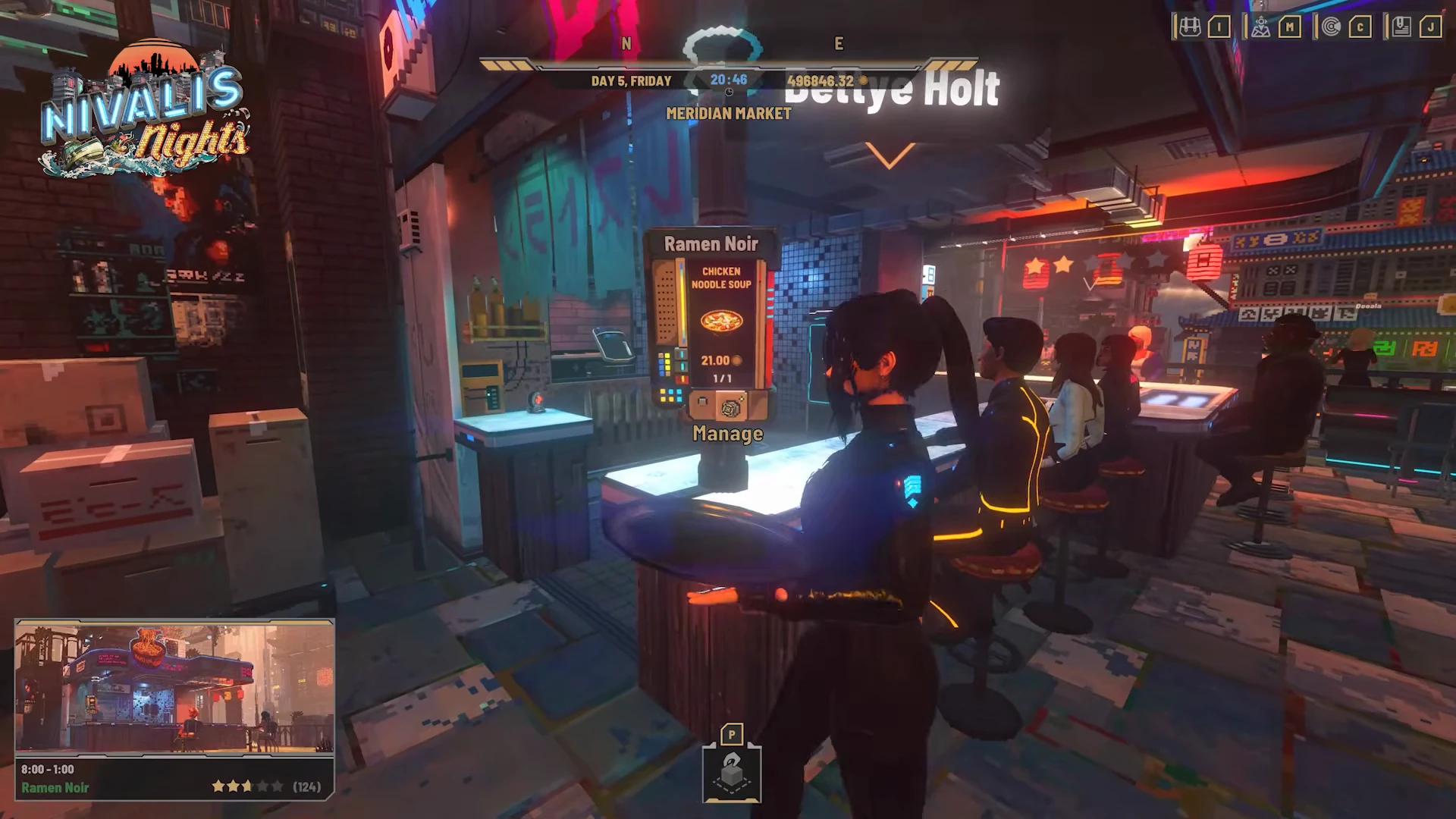
Your commercial journey starts with Ramen Noir, inherited from Thaddeus Carmunis. Counter service, tight inventory limits, and high manual involvement during peak lunch rushes.
Dedicated Ramen Bar
An enclosed brick-and-mortar storefront featuring seating booths, expanded prep stations, and dedicated customer tables. Accommodates higher patron turnover and supports multi-dish culinary menus.
Full-Service Restaurant
Extensive dining halls catering to business executives, tourists, and upscale diners. Requires multi-person kitchen staff, broad dish catalogs spanning seafood and steaks, and attentive table service.
Luxury Nightclub
High-energy nightlife venues capitalizing on evening and late-night revelers before the 2 AM curfew sirens. High-margin craft cocktail menus, extensive interior decoration buffers, and large staff overhead.
2. District Selection & Storefront Capacity
Expanding your enterprise requires choosing where to lease or buy commercial real estate. As revealed in the game's in-world navigation terminal (verified in our Districts & In-Game Maps Guide), commercial infrastructure varies substantially across sectors:
| District Name | Retail Storefronts | Strategic Character | Expansion Suitability |
|---|---|---|---|
| Central Canyon | 10 Stores | Dense commercial thoroughfare, high pedestrian volume | Prime target for Flagship Restaurants |
| Metro Hub | 9 Stores | Rapid transit terminal, constant commuter flow | Ideal for Quick-Service Ramen Bars |
| Hive Mall | 7 Stores | Vertical multi-tier retail hub, shopping crowds | Specialty Diners & Dessert Lounges |
| Meridian Market | 6 Stores | Canal-side market, wholesale ingredient docks | Starting Base & Fresh Food Stalls |
3. Independent Venue Menus & Demographic Targeting
A critical discovery confirmed in the official gameplay showcase is that menus are managed per-venue rather than globally:
"Manage your menus across the city — make sure customers are happy and leave good reviews."— ION LANDS Official Gameplay Showcase (u-ZvBHXUDoo)
Because each district attracts different social tiers—ranging from dock workers and transit commuters to corporate elites—running an identical menu across every storefront leads to suboptimal profits. Operators should customize offerings using dishes from the 9 confirmed culinary categories (see the 190+ Cuisine Recipes Guide):
- High-Speed Transit Hubs: Prioritize quick-turnaround soups, bao buns, and sandwiches for on-the-go travelers.
- Central Commercial Corridors: Feature premium synthesized steaks and complex multi-ingredient seafood dishes with higher price ceilings.
- Nightclub Spire Lounges: Focus on high-margin craft beverages, cocktails, and late-night snacks.
4. Venue Level 3: Unlocking Manager Automation
Operating multiple venues personally is physically impossible in Nivalis, where the player is constrained by the 24-hour day-night cycle, walking or boat transit times, and the strictly enforced 2 AM curfew sirens.
The developer has confirmed that venues feature progressive levels, and reaching Venue Level 3 unlocks the ability to hire and deploy Managers. For detailed shift assignments, review our Staff Management Guide. A Level 3 manager performs three essential operational functions:
Cross-Venue Restocking
Managers automatically order and replenish ingredient stock across your assigned kitchens, preventing expensive stockouts during peak rushes.
Greenhouse Courier Runs
Managers coordinate pickup of ripe crops from your greenhouses in the industrial district and route them directly into restaurant storage.
Staff Morale & Efficiency
Managers oversee floor workers, boosting service speed and overall staff performance without requiring the player's physical presence.
5. Confirmed Expansion Mechanics vs Operating Boundaries
✓ Developer-Confirmed Facts
- Four distinct venue tiers: noodle stands, ramen bars, restaurants, and nightclubs.
- Venue Level 3 is the explicit gate that unlocks the Manager role.
- Menus are configured independently per venue rather than globally.
- Managers restock ingredients and transport harvest yield from greenhouses.
- Customer reviews and interior decor directly influence venue popularity.
- Dedicated storage furniture expands venue capacity (Update #2).
⚠️ Operational Boundaries & Limits
- Storefront lease costs scale with district commercial density and foot traffic tiers; no published price table exists.
- No hardcap on simultaneous businesses confirmed yet, but management bandwidth limits rapid early scaling.
- Venue levelling appears to combine review performance with trading activity; ION LANDS has not published the exact thresholds. Update #3 did rebalance achievement unlock levels across all districts.
- Manager wages and restocking both draw on venue funds during end-of-day accounting, which is why Update #4's daily restocking budget matters once you run several locations.
6. Venue Storage Scaling & Furniture Integration (Update #2 Official)
As your commercial empire expands into multi-district restaurants and nightlife bars, managing storage volume becomes critical. In official Update #2 (Oct 2, 2026), decorative storage furniture now directly expands your venue inventory capacity:
- Kitchen Buffet Standardization: Now provides 100 standard storage slots plus 50 refrigerated storage slots. Placing multiple units inside larger restaurants prevents manager restocking overflows.
- FIFO Inventory Consumption: Cooking operations automatically draw the oldest ingredients first across your venue's storage network, keeping spoilage down while scaling operations.
To model potential operating margins and ingredient costs for your future venues, explore our interactive Business Profit Calculator.
❓Frequently Asked Questions
Can you own multiple businesses simultaneously in Nivalis Nights?↓
What venue types are officially confirmed?↓
How does menu management work across multiple locations?↓
When do managers unlock to help automate expanded venues?↓
Are storefront purchase costs or rental formulas officially published?↓
Does district choice impact customer foot traffic?↓
🔗Related Nivalis Guides
Set restocking targets and a daily budget for every venue you open.
Every official post-launch change to the business systems, in order.
What to do when an expanded venue starts losing money instead of earning it.
Learn the foundational mechanics of running Ramen Noir in Meridian Market.
Master hiring, shifts, and independent menu configurations across venues.
Evaluate retail capacity and vendor density across all major urban sectors.
Supply homegrown organic produce directly to multi-venue kitchen storage.